Tag: iran
I know the terrible cost of speaking out in Iran – and I beg the world to stand with those speaking out now
It has been more than 40 years since I was imprisoned in Iran for speaking out against human rights abuses and state executions, and for defending women’s rights. I spent eight years behind bars in Iran’s notorious Evin prison. I was tortured. I remember it as if it happened yesterday.
Every few years, uprisings erupt across Iran – and each wave of resistance is deeper and more widespread than the one before. In 2022, it was women who led the Woman, Life, Freedom movement after the murder of 22-year-old Mahsa Amini by the country’s “morality police”, and it revolutionised my country. Today, women wear what they want, go out in public with their boyfriends – even live with them – without fear of being arrested. Women earned these rights with their lives. In late December 2025, the spark was once again lit – this time in an old bazaar in Tehran.
The demands are the same ones we raised in the 1980s: an end to poverty, corruption and unemployment, the right to organise, and freedom from repression. Despite the gains for women’s freedoms made since 2022, workers are still denied basic labour rights. Students are arrested and even executed for peaceful protest. Women are still fighting for fundamental rights. People are still risking their lives to stand up to torture and state violence.
The regime’s response has been brutal. Human rights organisations report security forces shooting into crowds of largely peaceful protesters. I have seen heartbreaking images of families desperately looking for their loved ones among hundreds of body bags. The true death toll remains unknown, but reports suggest more than 2,000 people have been killed. Given the scale of the protests and the footage of violent clashes, the real number is probably far higher.
According to the Human Rights Activists news agency, by the end of the 17th day of protests 18,434 people had been arrested and, so far, 97 forced confessions have been broadcast on state television. These scenes bring back painful memories of my own imprisonment, where many people were tortured until they “confessed”. For survivors like me, moments like this reopen old wounds. I still see the faces of friends who were executed.
The regime is terrorising civilians, burning shops and destroying beautiful, historic bazaars. Doctors are reportedly prevented from treating the wounded. Injured protesters are taken away from their hospital beds. But despite the killings, people are still in the street. They say they have nothing to lose but their chains.
But the situation is changing so quickly. As of yesterday, military vehicles now patrol the streets in Tehran day and night, stopping anyone who dares go out. Only bakeries remain open, and people are leaving their homes only to buy the bare necessities.
Now, Iran has been plunged into an internet blackout. The regime wants to hide its crackdown from the rest of the world and stop Iranian people from organising. For those of us in exile, we wait in agony for news. I have not been able to reach my family and friends for more than a week. Watching the few grainy videos that reach us, survivors like me relive our worst nightmares.
When I fled Iran, I left everything behind – my family, my friends, my home. I was lucky though, I survived. I rebuilt my life. Many others did not.
Freedom from Torture has supported Iranian survivors like me for years, and in 2024 they assisted more people from Iran than any other country. For those who have escaped, the harrowing reports of brutality the world has been hearing since December are deeply triggering. We know exactly what the regime is capable of.
My heart aches for my country. Iran has gone through half a century of war against its own people. Our society is deeply wounded, but the status quo cannot continue, because the Iranian people will never give up fighting for their rights and freedoms. Iran’s rulers use torture to silence dissent and instil fear. They tried to take my voice away because I dared to dream of equality and freedom. Today, I use that voice to speak out about the horrors that continue, and to ask the world to speak up for Iranian people.
Since 2022, I’ve watched with dismay as global attention has drifted away from Iran. Silence only empowers those who torture and kill with impunity. The international community and the media must keep shining a light on what is happening.
We must raise the political cost of executions. We must demand the release of political prisoners. We must insist that the use of torture ends right now. We must stand shoulder to shoulder in solidarity with the Iranian people, in their struggle for what many of us in the UK take for granted every day: freedom, dignity and a life without fear.
I was tortured by Khomeini’s regime. This war is still unjust
Since the news that a girls’ elementary school in Minab had been hit on 28 February during ongoing US-Israel military attacks on Iran, the incident has received little sustained attention in Western media. This is despite local sources reporting scores of children among the dead and wounded, most of them primary school pupils. Days later, strikes were also reported near medical facilities in Tehran.
For people inside Iran the incidents are part of a growing sense that civilian life itself has become a target.
At the same time, Iran is experiencing one of the most politically volatile moments in its modern history. The death of Ali Khamenei has been met with conflicting reactions. It might feel strange to people of other countries, to see Iranians dance under bombs after hearing of his death, but I understand. Khamenei presided over a system built on imprisonment, torture, executions and the crushing of dissent.
For so many of us, me included, we wanted Khamenei and his henchmen to face justice in a courtroom, on trial for decades of crimes, repression and killings. I never wanted to see them killed by foreign forces but confronted by the families of those he helped destroy.
The death of Khamenei does not erase the crimes of the system he led. That structure must be dismantled, and those responsible should be held accountable through fair trials.
For survivors, this is not symbolic. Justice is how we reclaim our dignity and our agency. When change comes through foreign bombs instead of the will of the people, it sends the message that we were never capable of shaping our own future.
And none of this can justify foreign military attacks that kill innocent people. The death of one man does not legitimise the bombing of a country, the destruction of infrastructure, or the killing of children. Justice cannot be delivered by missiles.
Iran should be governed by the collective will of its people – not by force, and not by a figure selected or imposed by the United States or Israel. Real justice cannot be outsourced to foreign powers.
As someone who survived arrest, imprisonment and torture in Iran, one development is particularly terrifying. Reports indicate that Iranian authorities are transferring political prisoners from Evin Prison. For former prisoners like me, this is an unmistakable warning sign.
History tells us what can happen next. When the Iran-Iraq war began in 1980, prisoners were quietly executed. In 1988, following the end of that war, more than 5,000 political prisoners were killed in mass executions after summary proceedings. Many were buried in unmarked graves. Families were never told the truth.
Western governments often claim that military intervention brings freedom. People in the Middle East know this is not true. We have seen what war did to Iraq, to Afghanistan. We know that authoritarian regimes use war as a cover for repression, and that foreign powers are rarely interested in self-determination.
Iran does not need a ruler chosen by Washington or Tel Aviv. It does not need exiled strongmen or armed factions imposed as “alternatives”. It needs a political future shaped by its own people – without bombs overhead and without prisons filling up.
People in Iran have been living under a constant psychological threat of war for years. Last year, they experienced a taste of it firsthand; now civilians are being killed without any say in the matter.
Internet access in Iran is again severely restricted, leaving families inside and outside of the country struggling to contact loved ones, desperate for news of who is alive, who has been arrested, or who has simply disappeared. The fear is compounded by memories of past atrocities, like 40 days ago when the regime violently suppressed protests reportedly killing tens of thousands of people simply for asking for bread and freedom.
Life feels suspended, and uncertainty hangs over every household.
This war must stop. And while people in Iran have little power to halt it, people in countries like the UK do. These wars are waged in your name, with your tax money, by governments that claim to represent you. Protest matters. Pressure matters. Silence is read as consent.
This illegal war does not only threaten those on the frontlines in the Middle East. Every act of aggression destabilises the region, fuels cycles of violence, and makes all of us less safe. Stopping this war protects lives everywhere, not just in Iran.
Source: The New Arab
Who will stand up for the Iranian people as death rains on them from the skies?
I have been watching the news from inside Iran, unable to hold in my sorrow. As an Iranian who was imprisoned and tortured by the regime, I have been pleading with the world’s human rights organisations and media to keep a focus on the country’s plight. But now I see US-Israeli bombs falling on Iran, and some Iranians celebrating this war while innocent people die. My heart is breaking for my country.
Let us be clear: when Donald Trump and Benjamin Netanyahu conspired to launch their war, it was not out of a desire to free the Iranian people from the tyranny of the regime. Netanyahu said on the second day of the war: “This coalition of forces allows us to do what I have yearned to do for 40 years.” He has named this operation “Lion’s Roar”. Meanwhile, Iranian monarchists celebrate the carnage, waving the shah’s version of the country’s flag with its crowned lion and sun.
While the regime has chosen the new supreme leader, Mojtaba Khamenei, another man in exile is dreaming of becoming the king. Reza Pahlavi, the son of the former shah – whom Iranians struggled so hard to depose in the revolution of 1979 – now believes he is “uniquely positioned” to lead the country. He tweeted on 1 March: “My heart aches for the 3 American heroes killed and the 5 wounded by the regime. The Iranian people are forever in their debt. To their grieving families: please accept our immense love, deepest condolences, and eternal gratitude.” He is more American than Iranian. If he were truly Iranian, he would express sorrow for the thousands of Iranian civilians who have died in this latest attack, including more than 150 schoolgirls who are now believed to have been killed by a US strike.
We cannot judge the people in Iran raising the monarchist flag the same as those doing so outside the country. Some diaspora monarchists were once Islamic guards, and the US-Israeli war may bring them into power. Those in Iran experienced eight years of war with Iraq and know very well that war brings horror and death. They have since died many times over by the hand of the regime. A drowning person will try to grasp on to anything, even if it still pulls them down further. This is why some are accepting of Pahlavi. In 1953, the UK and US governments executed a coup that placed Pahlavi’s father, Mohammad Reza Pahlavi, in power. We are now witnessing an attempt to do something similar.
Trump, Netanyahu and Pahlavi have once again asked the people to rise up. I do not think people have already forgotten the last call for an uprising. On 13 January, Trump told Iranians: “Keep protesting … help is on its way.” No help came, and tens of thousands of protesters were estimated to have been killed. Trump has again told the people to rise up and “take over your government”. But no help comes – only bombs.
Netanyahu’s statement, Pahlavi’s similar call and Trump’s request for people to keep demonstrating in effect condemn people to death by allowing the regime to frame those who pour out on to the streets demanding bread and freedom as foreign collaborators. Since taking power, the regime has routinely executed activists by accusing them of being agents for the US or Israel. Alongside those who were killed in the recent uprisings, more than 50,000 were arrested. Among these innocent people are hundreds of children.
Making these demands – of innocent people in a country where collaborating with the US or Israel is punishable by death – is reckless and deadly. It appears to me that many powers feared the success of the people’s uprising. Not only the regime, but Israel and the US too have seemed very worried that people might overthrow the Islamic Republic themselves. An uprising led by ordinary people would be uncontrollable. That is why this regime change is being carefully managed and not allowed to emerge naturally from below.
Critics who say that the goal of this war is not Iran’s liberation, or that bullets don’t bring food and freedom, are then attacked by monarchists. “You are with us, or with the regime,” they say. This is how monarchists understand the politics of our time – as they were never politically active and they have never experienced prison or torture.
When the regime took power, my generation struggled against them. Tens of thousands of us were executed while many monarchists packed up and left the country. Monarchists have condemned Iranians who are against invasion and the murder of civilians. One of their slogans, I have heard, is: “Death to mullahs, leftists and Mojahedin.” Imagine that – after decades of executions by the regime, monarchists are now openly calling for the same noose to silence the same people.
Now that these powers are united against the people of Iran, the rest of the world should come together and stand shoulder to shoulder against this massacre of civilians from the sky. I am hoping that the people of the west will come out against this war and demand its end.
-
Nasrin Parvaz is a women’s rights activist and torture survivor from Iran. Her books include A Prison Memoir: One Woman’s Struggle in Iran, and the novel The Secret Letters from X to A
Source: The Guardian
Voices in the Middle: Iranian Protesters Between Ayatollahs and Airstrikes
“Both Russia and China have been using up resources in Iran. They don’t care what is happening to the people in the country. They don’t care what will happen to the regime, as long as they secure their profits. The only help they would give to the regime will be open doors for fleeing regime members when they have to run from angry Iranian citizens. There they can drink tea and wine with Asad, who once ruled Syria”, says Nasrin Parvaz in a written interview with Farooq Sulehria which is produced verbatim.
In 1979, following the rise of the Islamic regime, a series of misogynistic laws were introduced. Like many young people of her generation, Nasrin Parvaz became a civil rights activist, actively opposing the regime. However, in 1982, she was arrested and subsequently incarcerated, enduring eight years of torture in prison.
After her release from prison, she resumed her political activism in Iran. However, three years later, she was compelled to flee the country and sought refuge in the UK in 1993. In the UK, she continued her activism, voicing her opposition to various forms of oppression both in Iran and in other countries, including the UK itself. Most recently, she shared her experiences at a TEDx event in April 2025.
She acquired the skills to write about her life and create fiction at the Freedom from Torture writing workshop. Her publications include ‘One Woman’s Struggle in Iran: A Prison Memoir,’ which won the Women’s Issues category at the 2019 International Book Awards, and ‘The Secret Letters from X to A’ (Victorina Press, 2018). Her prison memoir has been published in Spanish and German, with forthcoming translations into Turkish and Kurdish by Aram Yayinevi in 2025. The translator for these editions, Mahmut Yamalak, has been imprisoned in Turkey for 31 years, serving a life sentence. Additionally, her novel ‘The Secret Letters from X to A’ is set to be published in Turkish by Aram Yayinevi in 2025. Her latest novel, ‘Coffee,’ received a long-list nomination for The Bath Novel Award in 2023. Furthermore, her poems and short stories have been featured in several anthologies, such as ‘Songs of Freedom—A Poetry Anthology by Ten Iranian and Afghan Women Poets’ (Afsana Press, 2024). Her works have also appeared in prominent publications, including The Guardian, The Morning Star, LBC, and Huck magazine, among others.
She has also translated poems from Farsi into English, which have been published in ‘Modern Poetry in Translation’ and various other anthologies. Additionally, she published a novel in Farsi about the 1988 massacre of prisoners in Iran, of which she was an eyewitness. Furthermore, her paintings have been accepted for inclusion in exhibitions at numerous galleries, including Sotheby’s and OXO Tower Wharf.
She pursued a degree in psychology and later obtained a master’s degree in international relations. Following this, she completed a postgraduate diploma in applied systemic theory at the Tavistock and Portman NHS Foundation Trust, where she collaborated with a team of family therapists. She is a member of Exiled Writers Ink (EWI) and the Society of Authors (SOA). For further information, please visit Official Website of Nasrin Parvaz.
President Trump said on July 23 that the USA might attack Iran yet again. Do you think Washington is likely to repeat attacks?
Nasrin Parvaz – It depends on what they want from the regime, and if the regime will accept it or not. For example if the regime resists a request for them to step down and reform their leadership then yes America may once again attack. In January 1979, America asked the Shah to leave the country and in February they escorted Khomeini into Iran. Of course, as in 1979, western governments decided this in their meeting in Guadeloupe and didn’t let any journalists into their meeting. So the people of the world didn’t know what the west had decided for Iran. Once again it is the same, we don’t know what the plans of the western governments are. In fifty years time the west will release their papers and evidence of what they decided in 2025 for Iran, and why they started illegally bombing the country.
Israel and America have not been ignorant of the regime chanting ‘Death to Israel, Death to America’ for the past 46 years and are not hearing it for the first time only now. One of the reasons that the west needs to change the regime in this particular moment is that they are afraid of people rising up in Iran as much as the regime is. Any change through the people in Iran would inspire others in the region to stand up for their rights against the western installed and backed regimes in their countries too.
Israeli-American bombings are designed to kill people’s revolutionary spirit as much as they are to destabilise the regime. This is done through assassination of the regime’s personnel, so people can’t find any reason to rise against a new regime. It’s like how the west asked Asad to leave Syria and replaced him with another criminal who was on America’s wanted list.
Those on the left, though not all, both inside and outside of Iran, opposed regime change without supporting the Ayatollahs. This was our position.
Nasrin Parvaz – Yes, fortunately many leftists opposed regime change because we know what it means. Iran has experienced two regime changes. First, in 1953 when the UK and the USA removed Mosaddegh and brought back the Shah who had originally fled from Iran in a coup. Secondly, then in 1979. Regime changes are only benefit the west and those at the top of the organisations, bringing nothing but misery for citizens.
The west has been propagandizing the monarchy in order to have an alternative to another governmental regime change in Iran. The Shah’s son praised the bombs landing in Iran and killing civilians. He has no interest in the wellbeing of innocent Iranians just like the Islamic Regime, the Israeli government and Trump.
Now that Washington and Tel Aviv have been unable to bring about a change, how do you evaluate the current situation? Can we consider the failure of the US-Israeli plan to be a positive development?
Nasrin Parvaz –
The plans of America and Israel are not finished. A coup is presently taking place at a brutally slow pace. This is a regime change. Israel hasn’t finished its attacks and it is still assassinating regime personnel. They use drones to explode apartments, houses and cars where regime members are present. With the death of each criminal, more innocent people who live in neighbouring buildings and streets are killed. Everyday people see fires and they know that it is Israel destroying the infrastructure of their society. The regime says there are gas faults or create other fictions to hide the truth. It doesn’t want to show weakness. The west looks the other way, not reporting any of the killing in Iran. The ceasefire never took place inside Iran. Only Iran stopped bombing Israel.
While mainstream media are not covering the issue, Iranian sources report daily on ongoing sabotage activities. Do you believe that Israel has altered its strategy and that the conflict is still ongoing?
Nasrin Parvaz – The Iran-Israel conflict isn’t new. Israel has been undertaking military activities in Iran and sabotaging the regime for many years. They had hit nuclear sights and other places before this year. To name just a few Israeli examples of sabotage before this round of attacks:
In 2024 they had a series of direct confrontations, and at one point in April 2024, the Israeli Air Force launched airstrikes targeting an air defence facility in Iran. They targeted an air defence radar site at an airbase near Isfahan, in central Iran.
On 14 February 2024, there was sabotage at nuclear facilities, natural gas pipelines and nuclear scientists were killed.
In April 2024, an Israeli airstrike demolished the Iranian consulate in Damascus, Syria, killing 16 people. Iran retaliated with missile and drone attack on Israel.
July 31, 2024, Hamas leader Haniyeh was assassinated by Israeli airstrikes during a visit to Tehran.
October, 26, 2024 Israel attacked Iran, striking air defence systems and sites associated with its missile program.
Israel is still launching drones into Iran every day.
To read more on Iranian People’s movement – ‘Iranian regime weakened by war but repression intensified post-ceasefire’
Do you think the Iranian regime is weaker after the war, or has it gained popularity by resisting the US and Israel?
Nasrin Parvaz – The regime is weak, because it has lost many top personnel. The regime hasn’t gained any popularity over the Israel-US attacks on Iran. It is not like the 1980s when people supported the regime during the Iran-Iraq war before returning from the battlefields in death shrouds.
People were already against the regime before the Israel-America attacks and there were many uprisings in Iran. This war didn’t make people support the regime.
Before the Israeli bombings another uprising was beginning to form in Iran. Truck drivers in more than 163 towns had been on strike for three weeks. More than 40 of them have been arrested. It was one of the biggest workers’ strikes in Iran to date. Their strike could have led to a national uprising because of a lack of food distribution, especially in bakeries essential to local people that had been affected.
During the last few days, despite Israeli operations inside Iran, people have come out of shock from the bombings and have started demonstrating and picketing against the regime.
Reports indicate heightened repression in Iran, where dissidents face imprisonment and severe punishments. What does such activity signify? Does it suggest that the regime has regained some legitimacy following the war and is now utilising its power to suppress dissent?
Nasrin Parvaz – During the bombings, prisoners who had been in prison for years were executed with the justification that they were Israeli spies. Arrests and executions are a part of life in Iran, and it shows that this struggle continues. There are prisoners who have been behind bars for 25 years. However, during the bombings the number of arrests was much higher than normal, thousands of people have been arrested.
War has always been an excuse to suppress people. More than five thousand prisoners were executed during the Iran- Iraq war in 1988. Fifty prisoners were taken from the wing I was in and they never came back.
Afghans have been expelled in their hundreds of thousands. While Iran claims to champion the cause of Ummah, how are people within the country responding to the expulsion of Afghans?
Nasrin Parvaz – It’s not only western governments like the UK that use immigrants as a scapegoat. The Islamic regime also blames poverty, lack of jobs, water shortages and electricity failures on refugees from Afghanistan. Just like in the UK, in Iran some people believed the lies of the government and have become racist, turning against innocent people from Afghanistan.
Before Israel attacked Iran, the regime had already created an anti-immigrant climate in the country where Afghans faced regular police violence and discrimination.
In 2024 the regime ordered all undocumented Afghans return to their country. In May 2025 the regime ordered mass deportations of more than 4 million immigrants. They gathered and deported them like slaves. Afghans born in Iran with valid visas have been deported. More than one million refugees were deported in 2025. Many of them were born and raised in Iran during the past four decades. Many of these people are totally integrated into Iran society. They have been ripped away from their lives and friends. The Iranian regime is uprooting Afghan people from their homes and communities. Children who were born in Iran are taken out of their schools and the only environment they grew up in to be deported to Afghanistan. People have had their homes raided simply for being of Afghan origin. They have been arrested and forcibly returned to Afghanistan.
Some Afghans, who were searched and were arrested in the street, were not allowed to go to their homes to pack their things. Some could not receive their rental deposits back after leaving their homes. They were just put on a bus and taken to the border. Many arrived in Afghanistan with no money, no food and no shelter.
Women, girls, activists and journalists who have been deported face high risk of human rights violations at the hands of the Taliban. Severe restrictions on women and girls await. Girls are very upset about not having the right to continue their studies.
Afghans have the lowest class status in Iran. The regime justifies its attack on Afghans by accusing them of ‘collaborating with Mossad to carry out internal terrorist attacks in Iran. Israel assassinated top officials whose addresses would have been inaccessible to Afghans.
Afghans are paid less than Iranian workers. Most of the recently built buildings in Iran, especially in Tehran, are made by Afghans. Yet some people have been brainwashed by the regime and blame Afghans for their own financial woes and treat them badly. For years Afghans have had no right to go to certain towns or areas. They have experienced terrifying discrimination, humiliation, ill-treatment and injustice from the regime and some of its citizens. Many have been facing violence, detention, and abuse.
It is not only Israel that displaces Palestinians from their homes. The Iranian regime is doing the same with Afghans but the difference is that unlike Israel, the Islamic regime doesn’t drop bombs on the Afghans. After the Israeli attacks the regime was like a wounded animal that struck out in anger and deported more than half a million Afghans in mere weeks.
This is the largest forced return in recent memory. Israel’s bombings increased anti-Afghan xenophobia in Iran. Poverty and the current anti-immigrant policies kill empathy in some people. Unfortunately, not many people support Afghans. They’ve believed the regime propaganda that Afghans are Israeli spies. I have seen clips on social media showing Afghans detained in prisons without water and food while waiting to be deported. They have to care for babies without essentials such as baby food. Some local people brought baby milk, nappies, bread and water for them. They tried to pass these things to the locked up Afghans underneath the door of their cages.
Many of these people will end up in Afghanistan carrying painful memories of state racism and an uncertain future. They have left behind everything they built and must start over with nothing but courage and hope. Afghan women are being sent back to a system that hates women for being women. Single women are denied shelter as they lack a male guardian. They are being deported to hell.
Everyone deserves safety and dignity, no matter where they are from. Collective expulsion is illegal. Iran is a signatory. It’s deliberate state policy. No access to asylum. No due process.
If a European regime like Israel can treat people in Palestine as it does today, why can’t the Islamic regime create this terror without condemnation?
Western governments handing power to the Taliban in 2021 caused more Afghans to seek asylum in surrounding countries. Thousands of women and children fled to Iran as refugees escaping from the Taliban.
Europe has said in the past that Afghans will be safe in Iran, and that they should seek protection regionally. Here we go. They’re very safe in the hands of the Islamic regime and Taliban as all can see.
Thank you to the western governments that replaced the Taliban in Afghanistan to put half the population, i.e. women, in prisons. Afghan women have to have the right of refuge based on gender apartheid. But gender-based apartheid is not recognised anywhere, especially in Iran, a country that also practises gender apartheid. Women are at risk in Afghanistan and shouldn’t be deported to it, but no one cares.
Women in western countries have to open their eyes to what their governments have done to women in Afghanistan. They should outstretch their hands towards the women in Afghanistan and try to guarantee women’s refugee rights for women who are living under gender apartheid in countries like Afghanistan.
The western governments that installed the Taliban into power owe the Afghan people. They should give them humanitarian visas and safe pathways for female Afghans and their families out of Iran in order to save them from the Taliban.
How come, the Iranian regime is worried for Palestinian brethren in the name of Islam but not Afghans. Do people in Iran point out these double standards?
I don’t believe that the Islamic regime is worried for Palestinians. When they say Palestine what they really mean is Hamas. While they only support Hamas, they say they support Palestinians. Some people in Iran don’t know the truth and believe what the regime says. They think the regime is supporting Palestinians. Since people in Iran have been kept poor, some accuse the regime of giving their money to Palestinians and they hold a grudge towards Palestinian people.
Some people don’t see the regime violating their rights and instead blame other people as directed by the regime.
Asad regime is gone. Hezbollah is weak. Tehran’s influence is declining in Iraq, according to some analysts. How will the changed regional situation determine regime’s future?
For so long the west has been trying to re-shape the Middle East. Western governments have been preparing to attack Iran for many years. Just as the lies told to justify the Iraq war were exposed, the same will be the case with this unlawful attack on Iran.
Israel has been telling the world that Iran will have a nuclear bomb in a few months since 2012 yet for some reason now was the right time to attack Iran. We can’t ignore people and their desires in 2025. We’re not living in 1953, when the west changed Iran’s history with a coup. The Iranian population, especially women, are educated and trying to change the country for good, rather than for what the west wants. People deserve a better life rather than seeing child labour or homeless children every time they leave their home. People want to get rid of unemployment and gain the right to have unemployment benefits and more rights that improve their lives.
I hope the west won’t be successful in replacing the regime with a puppet. I hope people determine the future of their own country.
China and Russia did not lend any meaningful support to Tehran during the war with Israel-USA. Not even diplomatic support of any consequence. Why?
These governments are exploiting other countries as much as they exploit their own people. Both Russia and China have been using up resources in Iran. They don’t care what is happening to the people in the country. They don’t care what will happen to the regime, as long as they secure their profits. The only help they would give to the regime will be open doors for fleeing regime members when they have to run from angry Iranian citizens. There they can drink tea and wine with Asad, who once ruled Syria.
There was a section of the left which declared the Ayatollah regimes as the last bastion of anti-imperialism during the US-Israeli invasion of Iran. How would you respond to the leftist efforts branding theocratic regime of Iran as anti-imperial?
It doesn’t matter how a person sees itself. The thing that matters is what they will do rather than what they say. They are pro-regime, like the Tudeh party that acted against people and sided with the regime for its slogans, ‘Death to America, death to Israel.’ The regime had another slogan, that was against Russia, but as time passed they realised that it’s profitable to lean on Russia. These parties too see themselves leftists, but they always act like right wing organisations. For me a leftist party would stand by people, not by any power. Unfortunately some European parties which call themselves leftist, support the Islamic regime for its slogans against America and Israel. They can’t stand by the Iranians who were oppressed by the regime for the last 46 years. They’re used to standing by institutional power.
During the 2022 Woman Life Freedom movement, some of these leftist parties didn’t support people’s struggle against the regime. Some of them were so disillusioned that they said this movement must be organised by America. They stood by the regime while school girls were arrested, raped and their bodies were dumped in the street.
Source: Alternative Viewpoint
I was a political prisoner in Iran — Tehran will use this moment to execute dissidents
In November 1982, Nasrin Parvaz planned to meet a friend and fellow activist in the Iranian capital, Tehran. She was shocked when her friend showed up at the meeting with an interrogator.
“I didn’t know he’d been arrested the day before,” Ms Parvaz, now 67 and based in Britain, told The i Paper. “He couldn’t take the torture, and named me. I was arrested.”
Ms Parvaz had been involved in demonstrations against the Iranian regime that had come to power following the revolution in 1979, bringing with it a fundamentalist and repressive interpretation of Shia Islam.
“The regime introduced misogynistic laws,” she said. “They said women had to cover their heads. Women did not have the right to divorce. Women had to have their husband’s permission to leave the country. Custody of children was the husband’s right. The law permitted men to kill their daughters and wives, and they went free.”
Ms Parvaz was taken to an interrogation centre for six months. “I was tortured because they wanted my contacts, and I wouldn’t give it to them,” she said. “My feet were lashed, so much so that I was paralysed for three weeks. The guards had to take me to the loo, and I couldn’t shower.”
She was transferred to Evin prison in Tehran, a notorious site holding thousands of prisoners, including hundreds of political dissidents, human rights activists, journalists and dual nationals. The prison, sitting on a hilltop surrounded by electrified barbed-wire fences, would become her home for most of the next seven years.
“Evin has a reputation of being a site of torture and oppression,” Nader Hashemi, director of the Alwaleed Centre for Muslim-Christian Understanding at the Edmund A Walsh School of Foreign Service, Georgetown University, told The i Paper. “Every major political dissident that has been arrested by the Islamic Republic of Iran has found themselves at Evin.”
Ms Parvaz was shown to a room meant to sleep five prisoners – instead, it housed 80 women and two children.

“I was beaten, but not like when I was at the interrogation centre,” she said. “I was put in solitary confinement, sometimes for months.”
She remembers becoming very ill in Evin with an unbearable pain in her stomach.
“I was at the point of dying,” she said. “I couldn’t eat anything and lost a dramatic amount of weight. They didn’t want to give me any treatment or medication, and said they would take me to hospital if I wrote my first confession – that I had made a mistake to struggle against the regime. I said I would not.”
Torture and War Will Always Create Refugees at TEDx University of St Andrews
My Torturers Tried to Silence Me, But Art Gave Me Back My Voice
More than thirty years ago, I suffered terribly at the hands of the Iranian government. I was imprisoned for eight years, and they tried to silence me with torture. All I’d done was take to the streets to demand my freedom and liberty from an oppressive and authoritarian regime.
The torturers tried to take my voice away. And therapy, writing and art played a vital role in helping me to express myself again. When I first came to the UK, after leaving my friends and family behind, I felt lost. But I was given support by organisations like Freedom from Torture that had a transformative impact on my life. I joined Write to Life, a creative writing group for survivors of torture. Through writing I regained my voice.

For many years writing was a means of escape for me. But art opened my eyes and I realised that it could be a way of fighting back, as well as a means of change. It can provide a counterpoint to what those in power and their media are showing to people. Art can change people’s minds. That’s why art is seen as a threat to power. Look how many artists are imprisoned in Iran from rappers, like Toomaj Salehi, to film makers and other artists.
Sharing my story through writing, and now through my art, is such a powerful way to tell difficult stories. It can give such an important insight into the very painful realities faced by those of us who’ve experienced torture. Today, I’m a member of Survivors Speak OUT (the UK’s torture survivor-led activist network) and I can raise awareness of the horrors happening in Iran. Being able to do this has helped give my life meaning since I had to leave my home.
I’ve listened and watched in terror at the violence that has swept across my country, since the death of 22-year-old Jina Mahsa Amini at the hands of the abusive “morality police” in September 2022. Although media interest is disappearing, the wave of protests sparked by Amini’s death haven’t died away, they’ve just changed. Instead of thousands taking to the streets, young people gather to dance, and women risk their lives and liberty just to sing.
Now, things like street dancing, singing, paintings and music are such an important way for people in Iran to protest. Many forms of art – like songs, digital art, videos, graffiti – have been created during the Woman, Life, Freedom revolution. Each of them emphasises protest actions, resistance, and different forms of activities against the regime’s repressive system. My own work explores personal and political journeys based on both my life and collective experiences that I have witnessed and heard about.


At first, I only wanted to show what had happened in prison, but now I have so many other ideas, I don’t have enough time to paint them all. My work explores the vulnerabilities of humans, of issues like refugee and women’s rights. I try and capture this in my work, regardless of the media I use, through drawing, painting, sculpture or print making.
When I first got to the UK, my head was full of the scenes of prison. All I could think about were the faces of my friends who’d been executed, the noise of the firing squad and the crying of hungry children in the prison, the torture that we experienced, and the face of my father when I told him I’d been sentenced to death. Therapy helped me to slowly clear these images from my head, and over time, I was able to feel safe and strong again.
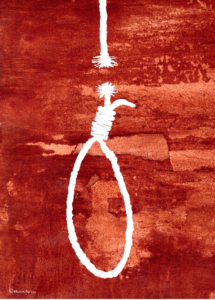
Still so many people in Iran have been imprisoned, they’ve been tortured and are languishing in prisons. I was lucky, I was able to get out. I’ve had the chance to recover and rebuild my life here in the UK. But my heart aches for the women who are still being subjected to the same kind of torture that I was. It’s horrific and depressing that this is still happening.
Iran is one of the top countries of origin of Freedom from Torture’s clients. There are many people like me who have fled their homes and reached the UK hoping just to live in safety. The therapists, lawyers and welfare advisors offer a lifeline to people who crucially need compassion, support and rehabilitation to recover.
Those in power in Iran now will do anything to try and suppress any opposition. Ex-prisoners, families of those still imprisoned, or anyone remotely politically active are being threatened and intimidated by security forces. It’s just more abuse carried out by an authoritarian regime that will stop at nothing to eradicate any form of defiance.
We need to continue to stand shoulder-to-shoulder with the women and young people demanding the basic rights that we, in other parts of the world, take for granted and enjoy every single day. I’m calling on the international community and media to keep shining a spotlight on my country to demand that the regime stop using torture immediately.
Nasrin Parvaz became a civil rights activist when the Islamic regime took power in 1979. She was arrested in 1982, tortured and imprisoned for eight years. Parvaz is the author of One Woman’s Struggle in Iran: A Prison Memoir and The Secret Letters from X to A.
Article originally appeared on Huckmag.
It’s time for Britain to show it really cares about Iranians
I feel more hope for Iran than at any time in the past 40 years — and more fear too. The regime assumed that brute force would crush the protests that have multiplied since the killing of 22-year-old Mahsa Amini in September, but instead of backing down, people from all walks of life have joined Iranian women in the streets.
As the regime’s hold on the country slips, its barbarism has increased. Tens of thousands have been detained. Hundreds have been killed, including at least 60 children. After the gruesome public hanging of Majidreza Rahnavard this month, scores more demonstrators could face imminent execution.
The families of those who have disappeared into Iran’s prisons fear the worst. Many know first-hand how the regime treats its prisoners. When I was arrested for protesting against Iran’s gender apartheid in 1982, I was tortured so badly I was left paralysed for three weeks. Eventually, I escaped Iran and found sanctuary in the UK. Thousands of those I was imprisoned with were not so lucky.
In the face of such brutality, the solidarity shown by Iranians is humbling. In the city of Javanrud, bakeries are distributing free bread to protesters. Across western Iran, an underground network has developed, smuggling blood and medical supplies to wounded protesters. In the diaspora, hundreds of thousands have flooded the streets in cities from London to Los Angeles, showing their support.
Last month, the British government told the UN that “the UK stands with the people of Iran”. But those who have been forced to flee for their lives are yet to witness this solidarity in action. Newly released government statistics show Iranians to be among the top three nationalities seeking asylum in Britain. Like me, many have experienced torture; Iranians are also among the nationalities most frequently referred for treatment to Freedom from Torture, the charity that helped me when I arrived in this country. But rather than being welcomed with kindness, they are threatened with instant deportation for daring to ask for asylum.
At the same time, the Iranian embassy in London remains open and regime acolytes continue to operate in the UK. Last month, The Times revealed that over £100,000 was paid by the UK to Ayatollah Khamenei’s personal representative through the taxpayer-funded coronavirus furlough scheme.
If the government is serious about supporting Iran’s uprising, it should crack down on the regime’s activities in Britain and send Iranian diplomats home. But most importantly it should treat Iranians fleeing for their lives with compassion and support them to rebuild their lives in this country.
Nasrin Parvaz is an Iranian women’s rights activist and torture survivor
Source: The Times
Petition: More Than 50 Political Prisoners Who Were Tortured Are Condemned to Execution in Iran
More than 50 political prisoners who were tortured and spent time in solitary confinement are condemned to execution. Some of them are condemned with two charges of execution and some are also condemned with public execution. All of them were born during the Islamic regime and were arrested in a peaceful demonstration.
Sign the petition here.